
On deadline, it can be tempting to paste an attendee spreadsheet into a free chatbot and ask it to organize the list. But that file contains names, contact details, and other personal data. Here are the risks to check before sending it to an external service, and the workflows an organizer cannot fix alone.
A familiar scene
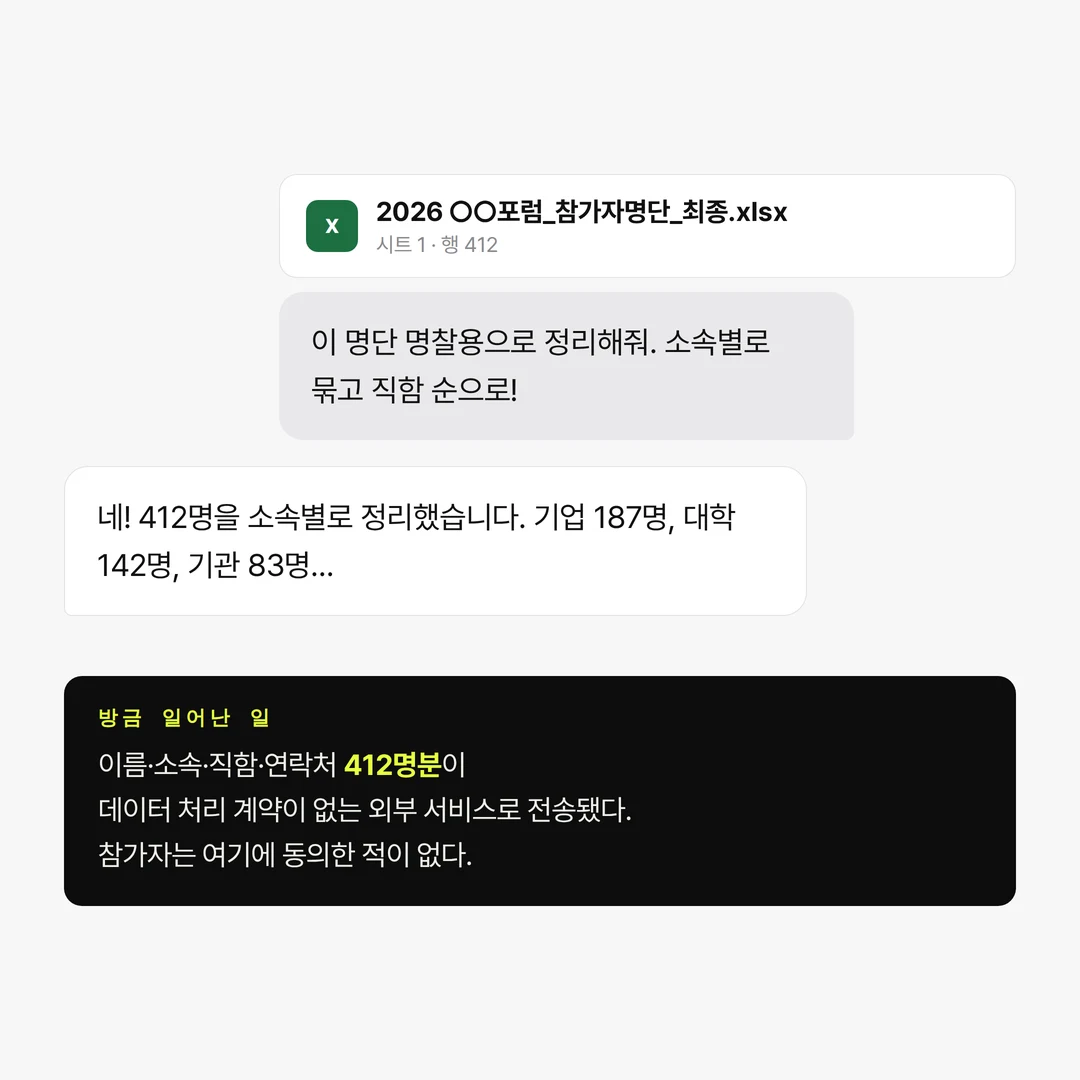
Two days before the event, the badge design is not done and the attendee list was just finalized. The spreadsheet holds names, affiliations, titles, emails, and mobile numbers. The organizer opens ChatGPT.
“Clean up this list for badges. Group by affiliation, sort by title.”
A tidy table comes back in thirty seconds. An hour of overtime disappears. Up to here, everyone knows this story. The problem is what comes next: what was just pasted is not 'work material' — it is the personal data of hundreds of people.
The numbers
Page 8 of Cyberhaven's 2025 AI Adoption & Risk Report gives the sensitive share of observed corporate data sent to AI tools by data volume: 10.7% in March 2023, 27.4% in March 2024 and 34.8% in March 2025. These are not percentages of ChatGPT conversations or prompts.
Cyberhaven's April 23, 2025 announcement describes analysis of actual AI usage patterns covering seven million workers. It is not limited to event organizers or Korean companies and cannot establish an event-industry leak rate. Attendee lists, speaker profiles, VIP information and unpublished drafts still warrant checking before transfer.
What goes wrong — three things
First, free chatbots come with no contract. Enterprise AI services can sign a data processing agreement (DPA) and commit in writing not to train on your inputs. Free and personal-tier chatbots have no such contract. Where the attendee list is stored and how it is processed is out of the host's control.
Second, the attendees never consented. Reread the privacy consent copy on most pre-registration pages: it is almost always limited to "event operation purposes." Feeding that list into an external AI service is very likely processing beyond the scope attendees agreed to. Korea's Personal Information Protection Act requires use within the purpose of collection. This is common-sense territory rather than legal advice — but it is why "potential violation" is not an exaggeration.
Third, there is no way back when something goes wrong. A misdirected email can at least be recalled, or a recall attempted. For data entered into an external service, recall is not even a concept.
And yet, it is not the organizer's fault
The conclusion of this piece is not "stop using chatbots." Deadlines are real, and list cleanup is real work. When there is a thirty-second path and a one-hour path, and the thirty-second path has no warning sign, people take it. That is not individual carelessness — it is a gap in the tooling.
Until now, event data has mostly flowed like this: collected in Google Forms, downloaded as a spreadsheet, passed around over messengers and email, and pasted into a chatbot when needed. Every one of those steps is a point where data leaves the host's control. The chatbot is merely the last one.
The alternative is structure, not prohibition
The principle we set while building our event registration and on-site operations systems is simple.
- When the pre-registration list flows through one system all the way to badge printing, the download-and-paste step disappears.
- When sorting by affiliation, title formatting, and badge layout are system features, there is no reason to ask a chatbot.
- When stats and summaries come straight from the admin dashboard, there is no need to ask an external service to "summarize this list."
The same holds after the event. When attendance data, check-in records, and per-session access are aggregated inside the system, there is no need to pull out the original list again to build the wrap-up report.
If your event is tomorrow — a five-line checklist
These apply right now, whether or not you adopt any system.
- 1Delete the personal-data columns before pasting. Most cleanup requests work fine without names, contacts, and emails.
- 2Use a work AI account under a company agreement. If your organization has an enterprise contract, use that account. If it does not, this article is your case for requesting one.
- 3Check the consent copy. Does the collection-and-use purpose on your registration page actually cover how the data is processed?
- 4Reduce the number of copies of the list. Every copy scattered across messengers, email, and personal laptops is a leak point.
- 5Set a post-event disposal date. Once its purpose is served, keeping the list is itself a risk.
In closing
AI is changing event work — that much is true. We built a website that AI search picks up, and we have documented that traffic turning into real inquiries. AI is an opportunity.
But on the other side of the opportunity is this scene: thirty minutes to deadline, an attendee list, a free chatbot. What removes the moment those three meet is not the organizer's willpower but the structure the data flows through. Building a structure where nothing needs to be pasted — that is one of the reasons we build registration systems.
FAQ
Why is pasting an attendee list into a free chatbot like ChatGPT a problem?
Free and personal-tier chatbots come with no data processing agreement (DPA), so the host cannot control where the list is stored or how it is processed. It is also very likely processing beyond the purpose attendees consented to.
Is an enterprise AI account okay?
Enterprise services can specify a data processing agreement and a no-training commitment, so they are safer than free personal accounts. You still need to confirm that your registration consent copy covers the actual processing and that it fits your organization's AI security policy.
Can I just delete the personal-data columns before pasting?
Most cleanup requests work without names, contacts, and emails, so it is the first measure to apply under deadline. It is not a full solution, though — combinations of affiliation and title alone can sometimes identify individuals.
Does entering an attendee list into an external AI violate privacy law?
Most pre-registration consent is limited to event operation purposes, so external AI input may constitute processing beyond the consented scope. Legal judgment on individual cases requires a qualified professional.
How does zzzarit's registration system handle this problem?
The pre-registration list flows through one system — badge printing, QR check-in, statistics, and final data. The principle is to remove the step of downloading a spreadsheet and pasting it into external services at all.
What should happen to the list after the event?
Once its purpose is served, keeping the list is itself a risk. Set a disposal date before the event, and clean up the copies scattered across messengers, email, and personal laptops as well.