
The most sensitive personal data at an event is not the attendee list. It is the resident registration numbers — Korea's national ID numbers — and bank account numbers collected from staff. And that data is still flowing through the most exposed channel available: the group chat. This piece is a record of why the practice is a problem, why it is not the organizer's fault, and how the collection path can change.
A familiar scene
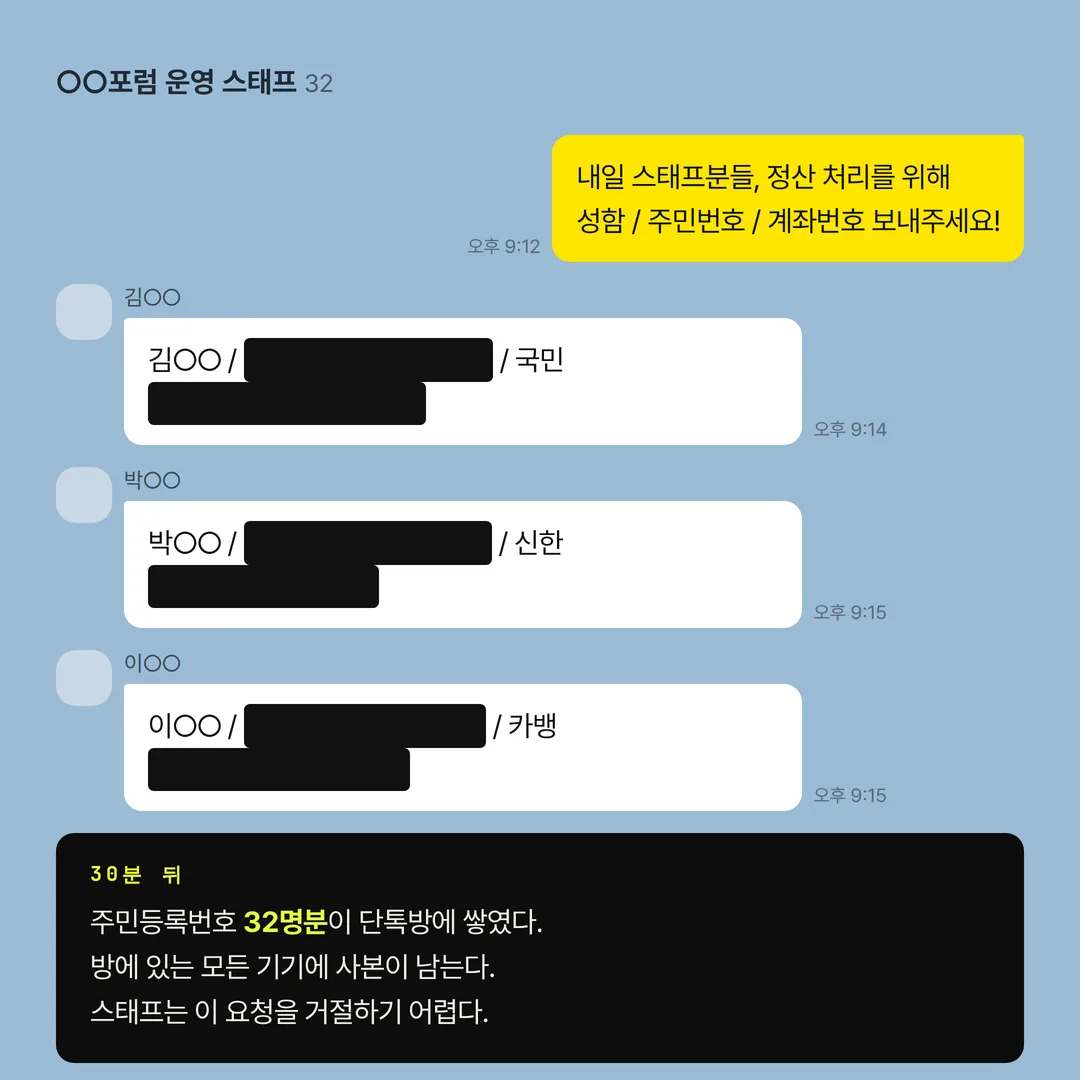
The night before the event, a notice goes up in the operations group chat.
“Staff working tomorrow: for payment processing, please send your name / national ID number / bank account!”
Replies pile up within thirty minutes. Twenty, thirty national ID numbers and bank accounts lined up in a chat room. The organizer copies them into a spreadsheet one by one. Anyone who has worked an event knows this scene.
Collecting them is not the mistake
One thing needs to be clear first. Paying temporary event staff requires withholding processing, and the payment statement filed for it carries the recipient's national ID number. That is a procedure tax law demands. Collecting the number is, in fact, work that has to be done.
Korea's Personal Information Protection Act acknowledges this. Processing resident registration numbers is prohibited as a rule, with an exception where a statute specifically requires or permits it. Withholding is exactly that case.
The problem is not the collection. It is the method.
Why the chat room is the problem
First, national ID numbers are data the law requires to be stored encrypted. Korea's safeguard standards under the privacy law require resident registration numbers to be encrypted at rest. A group chat is not a storage system that meets that bar. Numbers posted in the room stay on every participant's device, and they remain in the chat history long after the organizer has copied them out.
Second, uncontrolled copies keep multiplying. Ten people in the room means ten copies. Someone loses a phone, someone screenshots the thread, someone backs up the history on their way out — each of those is a leak point. From the moment the data is collected, it is outside the organizer's control.
Third, this is data you cannot take back. Unlike a name or a phone number, a national ID number cannot be easily changed after exposure. A change process exists, but it goes through a review committee and requires demonstrating a risk of harm from the leak. For most people, a leaked number is the number they live with for life.
And one more thing. Event staff are generally in no position to refuse the request. They are working tomorrow, and they need to be paid. The current practice collects the most sensitive data, from the people least able to say no, through the most exposed channel available.
And yet, it is not the organizer's fault
Picture the organizer the night before. The staff roster is only finalized that evening, the settlement data is due to finance the day after the event, and the only channel everyone is already in is the group chat.
When there is a thirty-second path and a path that requires standing up a separate system — and the second one does not exist — people take the first. It is the same structure we described in the piece about pasting attendee lists into a chatbot. Not carelessness, but a gap in the tooling.
The alternative is changing the path, not banning collection
The principle we set while building our temporary event workforce records workflow was a single line.
- Staff open an individual link on their own phone and enter the details themselves. Nothing lands in the group chat.
- The organizer does not have to hold raw ID numbers to receive a payment dataset organized for withholding processing.
- The collection purpose and retention period are stated on the submission screen, and the data is deleted through the agreed process once that purpose is served.
The organizer's workload drops too. Digging through the chat, retyping into a spreadsheet, checking for typos, asking everyone to delete the thread after the event — all of it disappears. Here, privacy protection and operational efficiency point the same way.
If your next event is coming up — a five-line checklist
These apply right now, whether or not you adopt any system.
- 1Do not collect through the group chat. At minimum use direct messages or a separate form. Stopping the pile-up in an open room is where it starts.
- 2State the reason and the retention period together. One line is enough: "For withholding processing; retained for N months after payment, then deleted."
- 3Delete the original messages after copying the data out. Not just your own copy — ask the senders to delete theirs.
- 4Password-protect the spreadsheet holding the ID numbers. It is the minimum lock while the file moves through email and messengers.
- 5Set a disposal date once settlement is done. The roster you keep for the next event is the biggest risk of all.
In closing
When we wrote about pasting attendee lists into a chatbot, a lot of readers said it hit close to home. But the truly sensitive data at an event is not on the attendee side. It is the national ID and bank account numbers collected from staff.
We know the data has to be collected, and we know the deadline is real. So the conclusion is not to stop collecting. It is to change the path the data travels — a structure where sensitive data goes straight into the system instead of through an organizer's chat room and spreadsheet. That is why we build workforce record systems.
FAQ
Is it allowed to collect national ID numbers from event staff?
Paying daily wages requires withholding processing, and the payment statement carries the recipient's resident registration number. Because a statute specifically requires it, the collection itself is permitted. The issue is not whether to collect, but how it is collected and stored.
Why is a group chat a problem?
Resident registration numbers must be stored encrypted, and a group chat is not storage that meets that standard. Copies remain on every device in the room and stay in the chat history even after the organizer has moved the data out, so uncontrolled copies keep multiplying.
What if the data was already collected through a group chat?
Organize what you need, delete the original messages, and ask the staff who sent them to delete theirs as well. Password-protect any file containing ID numbers and set a disposal date tied to the end of settlement.
Can something else be collected instead of the ID number?
The withholding payment statement requires the recipient's resident registration number, so substituting it is difficult. What can change is the route: when staff enter the details through an individual link, the data never passes through the organizer's chat room or spreadsheet.
When should the collected records be deleted?
Agree the retention period before collecting, and delete through the agreed process once it ends. The roster kept on hand for the next event is the largest single risk.
How does zzzarit's workforce records workflow handle this?
Staff submit their details through individual links, and the organizer reviews a dataset organized for withholding processing along with missing or incorrect entries. Collected fields, access rights, retention and deletion are agreed before the contract. Payroll calculation and tax filing are not included.