
What Are GEO and AIO? Building an Event Website AI Search Can Read and Cite
Search may now answer questions directly, but the foundation is familiar: publish accurate event information that is easy to verify.
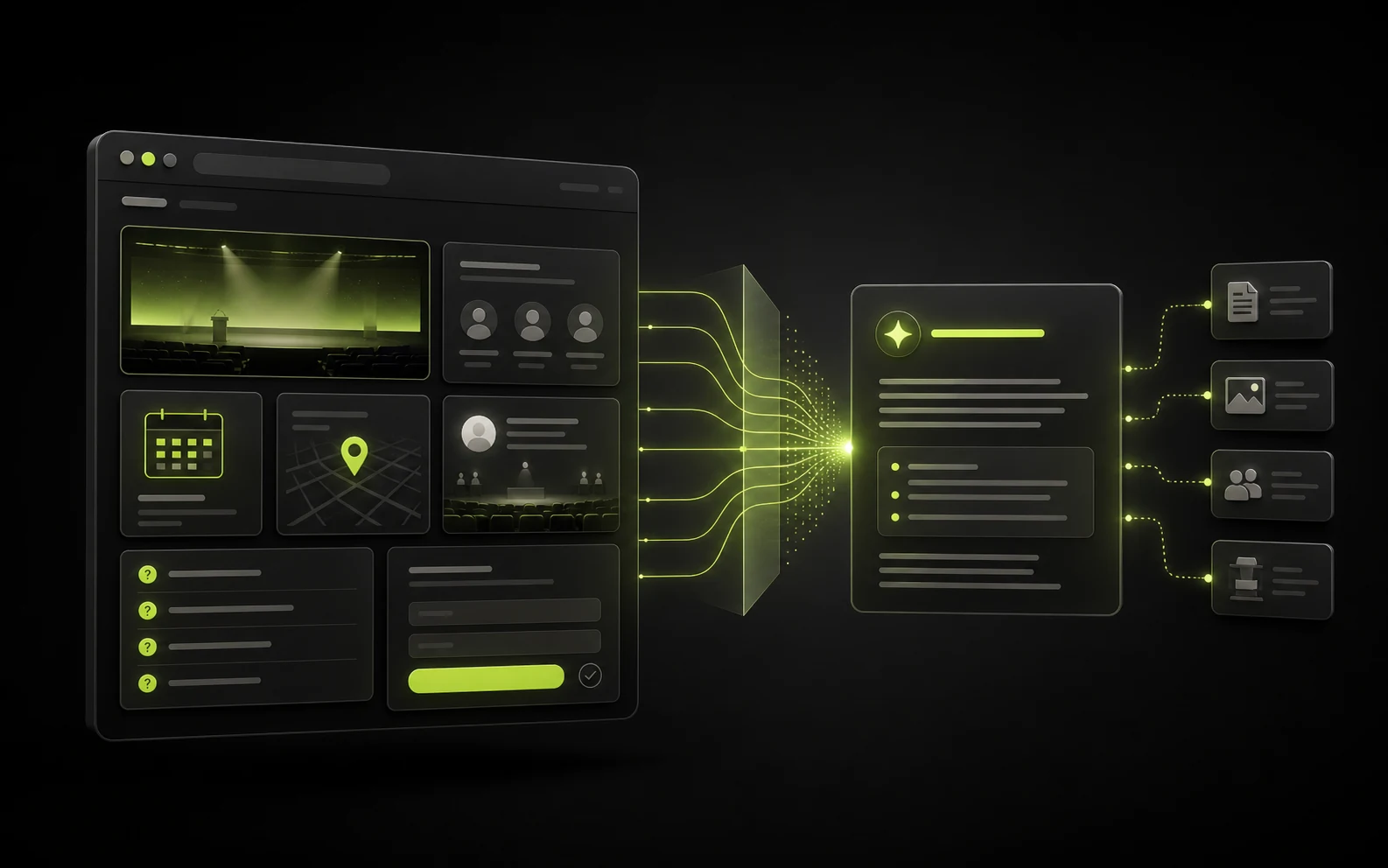
GEO (Generative Engine Optimization) and AIO (AI Optimization) are the work of making your pages readable and citable inside AI-generated search answers. Why it matters: if someone searches for your event and gets last year's date, the wrong venue, or no registration deadline in an AI answer, a lower blue-link ranking is not the biggest problem. Search no longer presents only a page list — it reads several sources, composes an answer, and attaches citations.
Start with the goal, not the acronym
GEO stands for Generative Engine Optimization. The GEO paper published at ACM KDD 2024 formalized the term around source visibility inside generative search answers. AIO is a loose practice and marketing shorthand that different vendors expand as AI Optimization, AI search optimization, and similar phrases. It is not an industry standard.
This is not a separate magic layer. Google's official guide updated in July 2026 says GEO and AEO are still SEO from Google Search's perspective. AI Overviews and AI Mode do not require special markup or a dedicated AI file. Search technical requirements and helpful, people-first content still apply.
What the research says, and what it does not
The GEO paper evaluated a benchmark of 10,000 queries. In that setting, content strengthened with sources, relevant quotations, and statistics improved visibility by as much as 40% under some conditions. Tests on Perplexity also improved selected metrics, while keyword stuffing performed worse than the baseline. Results varied by domain.
Those numbers describe a specific experimental setup, not a formula that guarantees growth for every website. Models and search indexes change, and platforms do not publish the full process used to select sources. GEO is best understood as preparing the conditions for official information to be discovered and used as evidence, not as a guaranteed ranking product.
Publish the event facts first
Verifiable facts matter more than polished slogans. If an attendee can answer a question from the page without calling the organizer, an AI system has a better chance of finding the same answer.
- Official event name, date and time, venue, organizer, and host
- Who the event is for and what attendees can expect
- Speakers, sessions, timetable, and schedule changes
- Registration method, deadline, price, and cancellation policy
- Transport, parking, admission process, and contact details
- Original sources for claims, including past event cases and statistics
Some pages are hard for AI to read
- The date and venue exist only inside a poster image
- The home, notice, and registration pages show conflicting schedules
- The page repeats vague claims without saying who the event serves
- Important pages have no internal links or block crawler access
- Structured data does not match the information visible on the page
OpenAI's publisher guidance says OAI-SearchBot must not be blocked if content is to be considered for summaries and snippets in ChatGPT search. Google likewise recommends keeping pages crawlable and indexable, putting important information in text, using internal links, and matching structured data to visible content. Strong copy cannot be used if a crawler cannot reach it or the key facts live only in an image.
What to measure instead of rank
The useful questions are which page was cited for which topic, and whether that visit led to an inquiry. AI Performance in Bing Webmaster Tools reports citations, cited pages, and sampled grounding queries. OpenAI adds utm_source=chatgpt.com to ChatGPT search referrals. If inquiry events are configured, GA4 can use that parameter to analyze which of those visits led to inquiries or quote requests.
Do not judge visibility from one prompt
AI answers vary with wording, timing, service, and user context. A single appearance or omission is not a trend. Use the same prompt groups in the same order each month so that you can separate change from chance.
- 1Branded prompts — what services and evidence are described when the company name is included
- 2Category recommendations — whether the brand appears when the name is omitted and an event operations or registration provider is requested
- 3Selection criteria — which factors the answer recommends for comparing event systems and registration platforms
- 4Problem-led prompts — which pages appear for queueing, badge issuance, or temporary-workforce records
- 5Solution prompts — which sources are cited for QR check-in, photo kiosks, NFC badges, and other individual products
A 30-minute monthly self-audit
- 1Search the brand and primary service terms to confirm that the intended titles, descriptions, and landing pages appear.
- 2Run the fixed prompt groups in ChatGPT, Google's AI search experiences, Microsoft Copilot, and Perplexity; add mentions, citations, and source URLs to the log.
- 3Check Google Search Console and Bing Webmaster Tools for query visibility, cited pages, crawl issues, and indexing changes.
- 4Connect AI-search referrals to quote and inquiry events in GA4 to see whether visibility became a sales conversation.
- 5Compare frequently cited external sources and competing providers, then prioritize the missing cases, numbers, third-party references, and direct answers for the next month.
This is not a league table. It is a way to choose the next improvement. If the brand is mentioned without a citation, strengthen primary evidence and project pages. If crawl checks pass but category prompts omit the brand, improve pages that answer comparison questions directly and work on independent reputation at the same time.
Answer vendor questions with criteria first
A useful answer to ‘Which company provides event operations systems?’ needs more than a vendor list. Compare planning-stage fit, busiest-30-minute throughput, the data lifecycle, responsibility for installation and incident response, and the final quote boundary. zzzarit publishes those five factors and the evidence a buyer can verify in its solution selection guide.
An official website matters even more when an event is not buying ads. A well-maintained schedule, speaker list, venue guide, and registration page can keep working across search results, AI answers, and shared links. Visibility cannot be guaranteed, but you can build a discovery path that does not begin with another paid impression every time.
The service is not limited to websites in Korea. We can improve an event website serving attendees anywhere in the world by reviewing its target language, market, and search environment. Korean developers you can trust handle the project directly, and English or multilingual pages can be included in the agreed scope.
FAQ
Are GEO and AIO completely different from SEO?
No. They extend familiar SEO work such as crawlability, clear content, internal links, evidence, and structured data to search experiences that compose answers and cite sources.
Will GEO make my site appear in ChatGPT or Google AI immediately?
No platform can guarantee inclusion or citation. Source selection differs by service and keeps changing. GEO prepares the technical and content conditions for official information to be found and cited accurately.
Do I need a dedicated AI file or special schema?
Google says AI Overviews and AI Mode do not require a dedicated AI file or special schema.org markup. Standard indexing requirements, crawler access, and structured data that matches visible content still matter.
Can this be applied to an existing event website?
Yes. We first review crawl and index status, consistency of key facts, internal links, structured data, and the path from a page visit to an inquiry, then define the needed scope.
Does every event website need this?
It is most useful for public conferences, academic meetings, expos, and recruiting events that attendees discover through search. It is a lower priority for private, invitation-only events.
Can zzzarit work on websites outside Korea or in other languages?
Yes. We do not limit the service by event location or target country. You work directly with Korean developers you can trust. We review the target language and search environment, then include English or multilingual pages in the agreed scope when needed.
How much does zzzarit's AI search readiness work cost?
It is a paid add-on for Basic and Premium event websites. Build a website quote and leave your contact details to receive the detailed amount by email.
Is one AI visibility check enough?
No. Answers vary by prompt wording, service, and time. Fix a monthly set of branded, category-recommendation, selection-criteria, problem-led, and solution prompts, then record mentions, citations, cited URLs, and inquiry conversion in the same format.
What should we do when competitors are mentioned but our company is not?
Do not keep repeating technical setup alone. Identify which prompts mention those providers and which independent sources and evidence support them. Use that gap to prioritize direct-answer pages, verifiable cases and numbers, third-party references, internal links, and the path to inquiry.